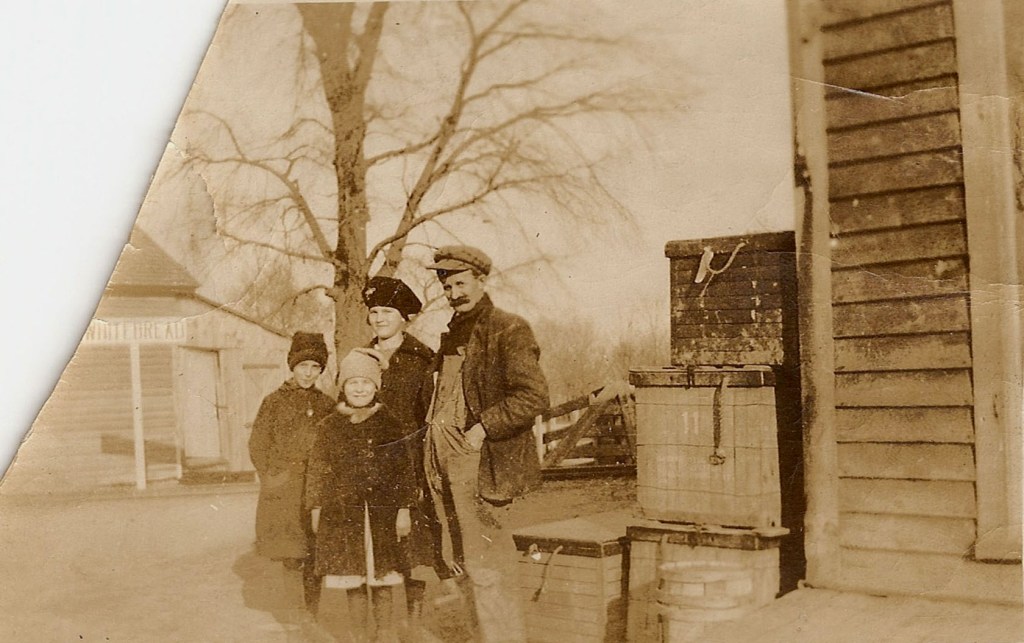
My maternal grandmother, Margaret Peers, was raised in the small community of Whitebread, Ontario located along the Chenail Ecarté (The Snye) – a tributary of the St. Clair River known that forms part of the western boundary between Chatham-Kent and the Walpole Island First Nation.
Whitebread was settled in the early 19th century at the intersection of Baseline Road and the Whitebread Line. It boasted a church, a general store and post office, and a school. A railway crossed the intersection and trains shipped grain and other goods to Wallaceburg (6 miles away) and points further.
After my grandfather passed away, my mother and I encouraged my grandmother to write down stories of her life. She began writing “Memories” on January 1, 1991. Her fondest (and most colorful) remembrances were of her time growing up in Whitebread. I have interspersed her own words in this post.
“Whitebread” was the name of the store and train station. The store carried all the supplies the farmers would need. There was barrels of supplies sitting around the store – also a big old stove where the farmers would gather to discuss the ills of the world . . . the store was just across the road from the school and next to the school was our Whitebread Methodist Church – a white clapboard building with a shed in back where the horse and buggies were kept while the parishioners were in church.
Mama [Caroline Macklem Peers] was the janitor of the church – so we would help her sweep and dust the pews – fill the stove with wood or coal as the season warranted – I think she was paid a small fee for that – it helped the family. Our whole activity centered around our school and church.
Everyone knew everyone in the small, tight-knit community. The families raised crops, harvested fruit from their orchards, and sold produce and eggs to sustain themselves. The children swam in the Snye in summer and ice skated in winter.
The big steamers (some) would come down the Snye to Wallaceburg to the sugar factory. We would wave and call to the captain and he would blow the horn to salute us. We had a dock out in front also a boat – wooden boat that we rowed all over. We even used to row up the river & cross the St. Clair River to go shopping at Algonac. The Tashmoo – a passenger boat – also came loaded with people from Detroit. We loved to get in the boat to take the swells as long as we didn’t go too close to the undertow. Our Snye river was a very special part of my life as a child – memories too numerous to remember them all.
In 1917, Libby, McNeil and Libby built a food processing plant in Chatham, thirty-five miles from Whitebread. One of their main products was pickles.
My Dad [William Henry Peers] was working for the Libby McNeil & Libby Co. He would travel around the countryside and contract with farmers to grow cucumbers. At Whitebread they built large holding tanks as it was very convenient for the trains to shuttle cars in there. The farmers would bring in the cucumbers, dump them on a sorting dock; little ones were one price, medium another & larger ones another price. They were then weighed and the farmer would be given a slip so the company then would send him a check to the station. It was a busy place in the summer for Papa & his helpers. He would then put the cucumbers in the special tanks that held brine of a certain degree. Each day the brine had to be tested. When they were cured they would be loaded in barrels & shipped to Chatham to the factory.
While this was a source of income for the family, the work kept my great-grandfather away from the farm, leaving the majority of the house and farm work to my great-grandmother. An entry from her diary on Monday, August 10, 1936 reads: “Cooked apple sauce, plums, potatoes, cut burdocks & weeds under 12 plum trees (very tired) picked 1 bus [bushel] plums . . . cleaned up oats in hen house.”
It makes me tired just to imagine a day like that! And, she was not done with her day because she still had to cook and clean and take care of her children.
Monday was always wash day – Tuesday ironing, Wednesday Mama baked to replenish the larder also did the mending. Thursday was Ladies Aid day or visiting, Friday cleaning. Saturday was the big bake day – several pies, a cake and 2 batches of cookies and crumpets – by Monday all would be eaten.
The clothes were scrubbed, rinsed in a second tub after they had been put in a large copper boiler on the stove. Mama had a nice round thick pole about 3 feet long which she used to stir the clothes while boiling – then would use it to lift the clothes out to the rinse tub. It was a regular production. She was very proud of her wash. She said you could tell what kind of housekeeper you were by the color of your wash.
Children in the area, including my grandmother and her siblings, attended the one-room schoolhouse at Whitebread. The original wooden frame building was later replaced by a larger brick structure.
The school was a red brick one room with a girls cloak room and also one for the boys – also a belfry that had a large bell and a big rope that was rung by the teacher for class to begin. The teacher was expected [to] and did teach everyone from first grade through 8th. She would start in the morning with first grade – give them their lesson . . . then go to second and on up each grade assigning work, spelling, writing, history, arithmetic and so on. In the afternoon she gave directions and help – and homework assignments – oh yes we had plenty of homework – pages of words to learn the spelling and meaning. Multiple tables to learn and memorize – problems to solve. The papers had to be turned in each morning to be corrected. The teacher had a long pointer which was used to point out certain things on the blackboard – also it was used at times to crack knuckles of some student who was misbehaving.
We once visited Whitebread for a family reunion and saw the farmhouse where my grandmother was raised but the school was a pile of rubble. My grandmother had tears in her eyes. I dug around a bit and managed to salvage a remnant of her past – a cobalt blue inkwell made of glass – which sits on my mantel to this day.
Sadly, there is no longer any sign of the Whitebread school. What used to be Johnson’s General Store is a residence today. The train tracks are covered with overgrowth. And all that remains of the church is the concrete steps that led to its front door and a commemorative sign. The once thriving (albeit small) community of Whitebread has faded away. Thankfully, we have my grandmother’s “Memories” to remind us of early 20th century life along the Snye.
 Historica Research
I loved this story and the description was so vivid and interesting, I could picture the entire scene!
LikeLike
Thank you! I’m grateful to have my grandmother’s memories to draw upon.
LikeLike